Fighting games are an intimidating genre to get into, it’s like chess but your fingers need to be a hundred times more nimble and instead of one opponent you have to be ready for dozens. Yet as of last year, I’ve started playing them. I never really had much of an interest, as I’m fairly bad at them, and being mechanically proficient at a game is not something that interests me very much. So, I didn’t play fighting games much until I discovered the animated Mortal Kombat movies, which introduced me to the brutal setting and characters. It was a hook I didn’t know I needed. I ended up getting MK 11, played the story mode, and had a good time, however, since I’m not striving to get great at combat but just experience the story and characters, I shortly stepped away from it.
The game has an arcade mode that offers small ending rewards for each character, but because the story of the game is very meta-narrative, most character endings involve them becoming gods and shaping the universe in their image. This usually meant that all good characters had similar endings, and all bad characters had their own predictable conclusions. While it served as a reward, it didn’t offer much insight into the characters’ personalities or motivations, so I didn’t bother playing through all the endings. I tried multiple other fighting games with similar results. I’d quickly put them down before even trying out all the characters.
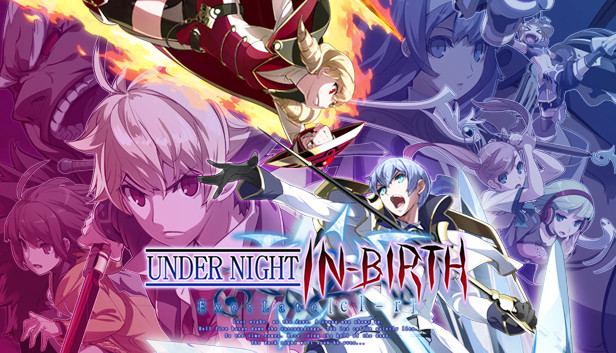
Then I found two games by the developer Soft Circle French-Bread that had me hooked for hours longer than any other: MELTY BLOOD: TYPE LUMINA and UNDER NIGHT IN-BIRTH Exe:Late. Both are beautifully animated pixel-art fighting games with very out-there stories that are kind of hard to follow but captivating enough to pull me in. I ended up beating the story mode and additional arcade modes in both games so I could learn more about the characters and settings. Afterward, I even started looking online for explanations of the lore to confirm my ideas about the characters and the world.
With this inspiration I want to explore how these games’ very simple narrative rewards kept me engaged, unlike the major fighting game titles.
Let’s first talk about the presentation. Games like Mortal Kombat and Tekken have very fancy production with fully animated 3D cutscenes, whereas games like MELTY BLOOD: TYPE LUMINA and UNDER NIGHT IN-BIRTH Exe:Late tell their stories through visual novel segments. Simple character cutouts talking to each other with voice acting layered on top. The production value is clearly better in the big games, but I think it also holds itself back because of it.
Since the cutscenes in 3D are more involved, the amount of story content they can include is limited. That leads to smaller, less frequent story beats. On the other hand, the visual novel style allows for small cutscenes between characters every few fights. This means that each character gets much more extended screen time, giving every character more time to shine. Seeing the different interactions between characters exposed me to different parts of that characters’ personalities which motivated me to try them across the story and arcade modes.
I understand that this method of storytelling isn’t for everyone. Visual novels require people to read for an extended period and it can become a chore. I personally won’t read visual novels unless they have some kind of active gameplay mechanic and voice acting to help along with the reading. Great examples of this are the 999 series and Professor Layton, where the player alternates between visual novel storytelling and puzzle-solving gameplay. I think that oscillation between active and passive gameplay works fantastically, and due to the lower production workload, it allows for more story content that the player can actively engage with.
In contrast to the name brand and recognition and familiarity of games like Mortal Kombat I had no idea what the games were about, who the characters were, or what the plot of the story was for MELTY BLOOD: TYPE LUMINA and UNDER NIGHT IN-BIRTH Exe:Late. Yet, even though it had a lower production value I’ve come to be interested in the world and character far more than that of its high budget counterparts. Putting in significantly more hours into these games because their extensive narrative kept me hooked.
I found it fascinating to piece together the relationships between characters based on their cutscenes. Realizing things like, “Oh, this character is that character’s sister,” or “This one is the arch-nemesis,” or “Oh, there are vampires in this world and a holy order fighting them, and it’s all happening in this small town in Japan.” Thanks to the visual novel style, each character gets to build a rapport with a few others, and the web of relationships builds in your head. Thanks to the amount of cutscenes that the game provisioned I got to see different sides of characters depending on who they were interacting with. This is in stark contrast where in MK or Tekken you’re most likely to see the protagonists’ relationship explored but very little for the side characters.
Now, due to alternative endings across the arcade mode, the overarching story isn’t always clear, but the world and characters are established strongly enough to make you want to learn more and keep you coming back even after you finished the story mode.
As I continue developing games, I want these narrative techniques alive in my games. Giving players a strong setting, characters and allowing them to experience those relationships over a longer time, even if it means sacrificing flashy presentation. I would be happy to play a few matches to see how Character A and Character B play off each other in a given story context. Each character has the potential to be someone’s favorite, let’s not waste that opportunity by sending them into a throng of meaningless matches without any payoff.
 Orczuk